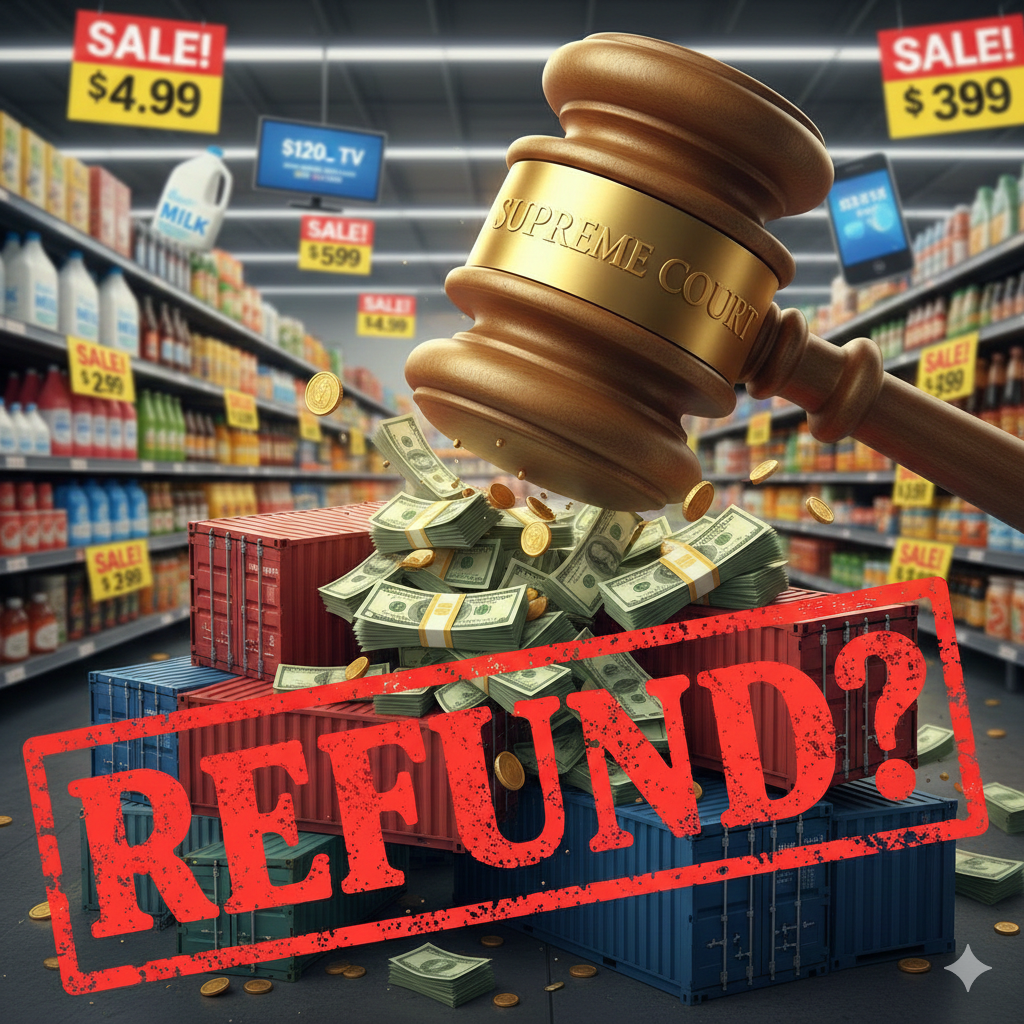
The Supreme Court just struck down a major set of tariffs imposed by President Donald Trump, and the decision could have real implications for your finances. Those tariffs already collected hundreds of billions of dollars. Now people are asking a very simple question: do we get any of that money back?
If you've bought groceries, appliances, electronics, or really anything imported over the past year or two, there's a good chance you paid part of those tariffs without even realizing it. This ruling matters more than it might seem at first — and what happens next could affect your costs, your taxes, and possibly even future checks you might receive.
What Actually Happened
The Supreme Court ruled 6-3 that President Trump did not have the authority to impose these broad tariffs under a law called the International Emergency Economic Powers Act (IEEPA).
That law was originally designed for emergencies — things like freezing assets or blocking financial transactions during a crisis — not for putting taxes on imports across the board. The court essentially said that if you're going to tax goods coming into the country, Congress has to clearly approve it. The president can't just do it alone under a general emergency law.
Key Takeaway: The tariffs were ruled invalid not because tariffs themselves are illegal, but because of how they were implemented.
The $200 Billion Question
Here's where things get interesting. The government already collected over $200 billion from these tariffs. Some estimates say at least $175 billion could potentially be subject to refunds. That's a massive number.
Naturally, people are asking: where does that money go now?
Here's the surprising part — the Supreme Court didn't actually decide whether refunds have to happen. They left that question open. So right now, the answer is: we don't fully know yet.
Most of those tariffs were paid by importers — companies bringing goods into the US. Those companies then passed the cost along to consumers, meaning people like you and me. So even if refunds do happen, it's not automatically clear who gets the money.
Even Justice Kavanaugh, who dissented in the case, said this could turn into a situation where the government might have to refund billions — and that the process could be, in his words, "a mess."
How Tariffs Already Hit Your Wallet
Research shows that tariffs increased costs for households significantly:
• Average household impact: Over $1,000 per year in higher prices
• Affected products: Electronics, cars, appliances, everyday goods
• Hidden costs: Even if you never saw a line item that said "tariff tax," you likely felt it in higher prices
Those costs rippled through the entire economy. And that leads to the big question: will you actually see a refund check?
Three Possible Paths Forward
Right now, there are three possible scenarios:
Path 1: Refunds Go Only to Importers
Companies get the money back, and consumers may or may not benefit depending on whether prices come down. This is probably the most straightforward legally, but not necessarily satisfying for everyday people.
Path 2: Broader Refunds or Structured Returns
Congress could step in and decide how to distribute funds, possibly even sending money directly to households. There was even talk previously about something like a $2,000 tariff dividend, though that now looks uncertain given the ruling.
Path 3: No Refunds or Very Limited Ones
The government could argue that the tariffs were collected in good faith at the time and that refunds would be too complex or disruptive. This would almost certainly lead to more lawsuits — and we're already seeing over a thousand cases related to this issue.
Key Takeaway: This is far from settled. The legal and political battles are just beginning.
What About New Tariffs?
President Trump has already responded by saying he plans to move forward with new tariffs using a different law — specifically Section 122 of the Trade Act. So even though one door closed, another is being opened.
This ruling doesn't mean tariffs are gone. It just means the way they were implemented in this case wasn't allowed. Other types of tariffs — like those based on national security or unfair trade practices — are still in place.
The Bigger Picture: This is really about who has the power to create tariffs. The Constitution gives Congress authority over taxes and trade, and the court is reinforcing that boundary.
What This Means for You
Even if refunds are approved, this could take years. Court cases, appeals, administrative processes — it's not like flipping a switch. And if the government does issue refunds or payments, where does that money come from? It's already been collected and likely used in the federal budget.
So what should you actually do with this information?
• Stay aware: Keep an eye on how this develops, especially for refund programs or policy changes
• Watch prices: If tariffs are reduced or removed, you might see gradual changes in costs
• Prepare for uncertainty: New tariffs under different laws could shift things again
Conclusion
The Supreme Court's ruling marks a significant moment in trade policy, but it's just the beginning of a longer process. Whether you'll see money back in your pocket remains uncertain. What's clear is that this affects everyone who buys imported goods — which is virtually all of us.
The best thing you can do is stay informed and understand how these policy decisions impact your day-to-day finances.
Frequently Asked Questions
Need Help? Let's Talk!
Have questions about this topic or need personalized guidance? Our team at JKJ Enterprises is here to help you navigate your options.
Contact Us Today